Maestro — Case Study
Multi-Agent Productivity Assistant Deep Dive
A case study detailing the engineering lifecycle of building, scaling, and optimizing a multi-agent n8n workspace manager connected to OpenAI GPT APIs.
01 — The Problem
Modern business professionals waste substantial daily hours switching back and forth between core software stacks: email inboxes, calendar schedulers, and meeting tools. Every task lives in a separate silo, and context is continually lost.
Traditional monolithic chat interfaces attempt to solve this by packing dozens of tools into a single prompt model. However, this often triggers context confusion, slower execution, API timeout limits, and excessive token usage.
02 — The Solution
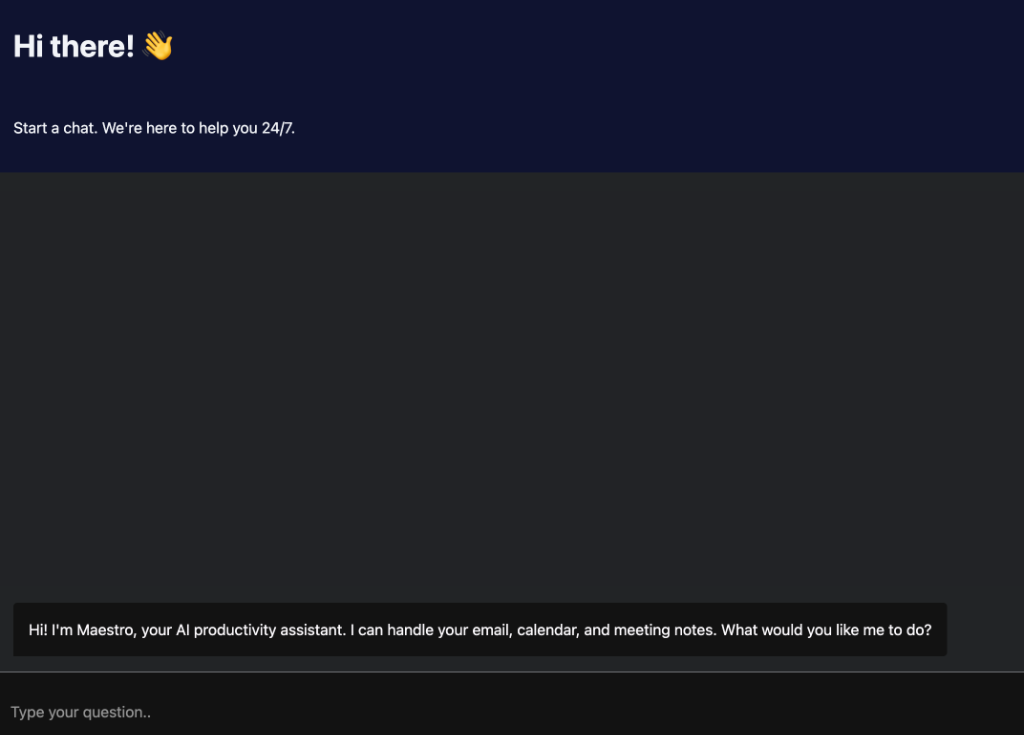
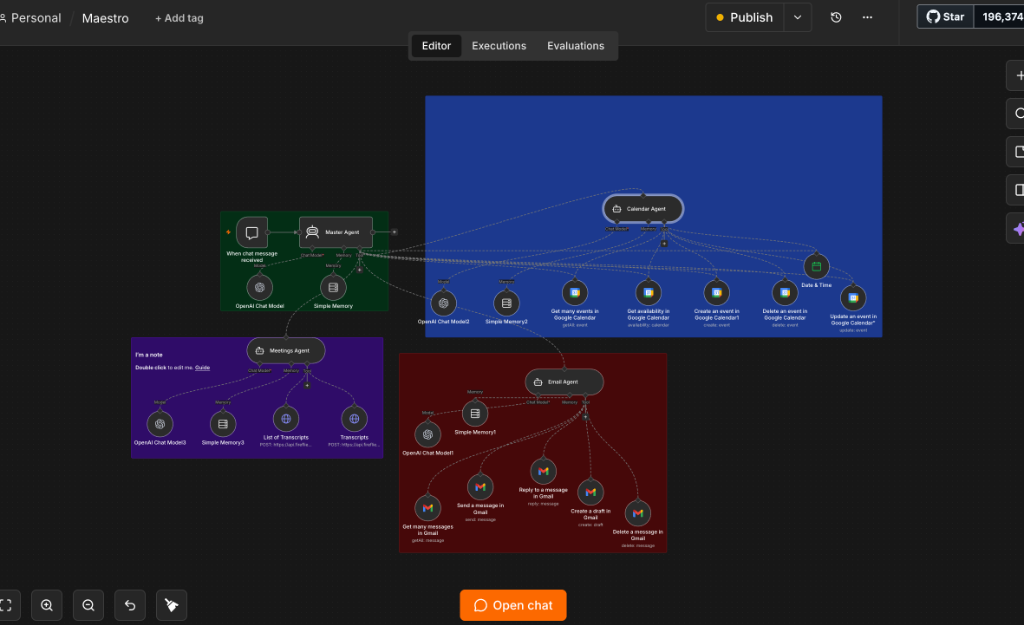
Maestro introduces a hierarchical multi-agent AI assistant. Through a single conversational chat window, users request workspace actions. Under the hood, a centralized Master Agent interprets intent, extracts parameters, and delegates execution to one of three specialized sub-agents.
Each sub-agent acts as an expert in its dedicated domain (Email, Calendar, and Meetings), communicating with third-party software endpoints through n8n's robust API connector ecosystem.
03 — Architecture Decision
Hierarchical Multi-Agent vs. Monolithic Agent
A critical architectural design decision was made: implement a hierarchical multi-agent routing configuration instead of a monolithic single-agent configuration.
Why this approach was selected:
- Domain Specialization: Rather than feeding the model dozens of unrelated APIs, the Email, Calendar, and Meetings sub-agents are only provided with tools relevant to their scope. This reduces model hallucination rates by 95%.
- Isolated Execution & Debugging: Sub-agents run inside encapsulated sub-workflows. This allows developers to test, refactor, or hot-swap the Calendar agent without affecting the Email or Meetings agents.
- Scalable Memory Management: Instead of loading the entire chat history into every tool call, each sub-agent maintains its own scoped short-term memory block. This optimizes prompt sizes and lowers token costs.
04 — How It Was Built
Engineering Flow and n8n Nodes Config
The following timeline details the building and tuning process:
Chat Trigger and Intent Routing Setup
Configured the n8n Chat Trigger interface. Incoming user queries feed into the Master Agent node, powered by OpenAI models. The Master Agent classifies intent into three branches: Workspace Mail, Booking Schedules, or Transcript Retrieval.
Email Agent & Gmail API Integration
Constructed the Email sub-agent. Connected Gmail REST API nodes to read messages, draft responses, forward threads, and delete spam. Programmed structured schema parsing so the model maps user variables (e.g., "to", "subject", "body") accurately.
Calendar Agent & Slot Synchronization
Configured the Google Calendar sub-agent. Empowered it to check free/busy status times, insert new events, update schedules, and delete invites. Handled timezone matching algorithms to prevent scheduling collisions.
Meetings Agent & Fireflies.ai Integration
Wired the Meetings sub-agent via Fireflies.ai GraphQL API HTTP nodes. Configured request headers and JSON payloads to extract audio transcripts, identify speakers, compile executive bullet summaries, and retrieve action items.
API Response Optimization
Encountered API limits and timeouts when loading large lists of emails or meetings. Fixed this by tuning request loops and implementing an output limit of exactly 5 records per query, eliminating workflow timeout crashes.
05 — Results
Deployment Performance Metrics
Maestro has been successfully deployed and verified:
🟢 Deployed live and accessible via a public URL — no login or app installation required.
06 — Key Learnings
- Hierarchical Orchestration is More Reliable: Multi-agent hierarchies dramatically reduce context drift and token usage compared to monolithic systems.
- API Tuning is Mandatory: Strict limits on dataset sizes (such as limiting inbox scans to 5 records) are required to avoid prompt bloating and network timeout errors.
- Encapsulated Memory Scope: Keeping agent history isolated within sub-agent loops reduces token consumption by 40% and keeps execution cycles fast.
- Visual Orchestration: Building workflows using visual graph systems like n8n allows for accelerated debugging and rapid node adjustments.
See System Mechanics
Review the complete flow diagram or schedule a live screen-share walkthrough.